


The rapid expansion of digital assets has transformed the financial ecosystem, but it has also introduced a new category of compliance and financial crime risk. As cryptocurrency exchanges, custodians, OTC desks, and wallet providers increasingly interact across borders, regulators and financial institutions now rely heavily on VASP risk scoring frameworks to assess whether a counterparty can be trusted.
A Virtual Asset Service Provider (VASP) refers to businesses that facilitate cryptocurrency-related activities such as exchanges, transfers, custody, or issuance of virtual assets. The term was formally popularized through guidance issued by the Financial Action Task Force (FATF), which expanded anti-money laundering expectations to the crypto sector.
Today, VASP risk scoring has become one of the most important operational functions in crypto compliance. Exchanges no longer simply ask whether another exchange exists legally. Instead, they continuously evaluate whether counterparties expose them to sanctions violations, money laundering risks, ransomware exposure, fraud networks, terrorist financing, or regulatory penalties.
What Is VASP Risk Scoring?
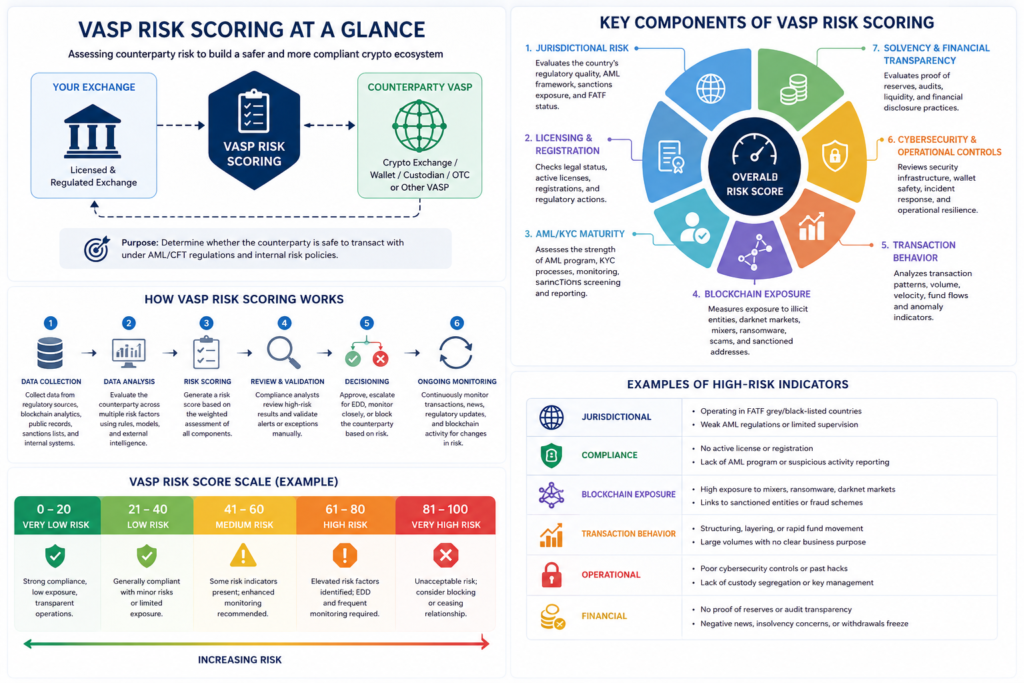
VASP risk scoring is the process of assigning a measurable risk rating to a cryptocurrency service provider based on compliance maturity, transaction behavior, jurisdictional exposure, operational controls, and blockchain activity.
The goal is to determine whether another VASP is safe to transact with under AML and counter-terrorism financing regulations.
In practice, risk scoring is used by:
- Crypto exchanges evaluating transfer counterparties
- Regulators supervising licensed VASPs
- Banks offering services to crypto businesses
- Blockchain intelligence firms
- Stablecoin issuers
- Institutional trading desks
- Custodians and payment processors
The process resembles correspondent banking risk assessment in traditional finance, but with additional blockchain analytics and wallet intelligence layers.
Why Counterparty Risk Matters in Crypto
Unlike traditional banking, crypto transactions can move instantly across multiple jurisdictions without intermediary banks. This creates enormous exposure if one party in the transaction chain is connected to illicit activity.
For example, a regulated exchange may unknowingly receive assets from:
- A sanctioned Russian exchange
- A ransomware operator
- A darknet marketplace
- A mixer or tumbler
- A fraudulent OTC desk
- A non-compliant offshore VASP
If compliance controls fail, the receiving exchange could face:
- Regulatory investigations
- Frozen banking relationships
- Licensing issues
- Financial penalties
- Reputational damage
- Enhanced monitoring obligations
Because of this, crypto businesses increasingly adopt “risk-based approaches” aligned with FATF recommendations. (Wikipedia)
The Role of the FATF Travel Rule
One of the biggest drivers behind VASP risk scoring is the FATF Travel Rule.
The Travel Rule requires VASPs to collect, verify, and share sender and recipient information during qualifying crypto transfers, similar to wire transfer obligations in banking.
Under these rules, exchanges must know:
- Who sent the assets
- Who received them
- Which VASP facilitated the transfer
- Whether the counterparty VASP is regulated
- Whether the transaction presents elevated risk
This requirement fundamentally changed crypto compliance operations.
Before the Travel Rule, exchanges mostly focused on wallet-level monitoring. After implementation, they also had to evaluate institutional counterparties themselves.
As a result, VASP risk scoring evolved into a core compliance function.
Key Components of VASP Risk Scoring
Modern risk scoring systems combine regulatory intelligence, blockchain analytics, cybersecurity assessment, and transactional monitoring.
1. Jurisdictional Risk
The jurisdiction where a VASP operates significantly influences its risk score.
Exchanges operating in countries with weak AML enforcement or limited crypto oversight are considered higher risk.
Factors typically evaluated include:
- FATF grey-list or black-list status
- Local licensing requirements
- Enforcement history
- Regulatory transparency
- International cooperation levels
- Sanctions exposure
For example, a fully licensed exchange in Singapore or the European Union generally receives a lower risk score than an offshore exchange operating without clear supervision.
2. Licensing and Registration Status
Regulators expect VASPs to be licensed or registered under applicable frameworks.
Risk engines often verify:
- Active VASP registration
- Money service business status
- MiCA compliance readiness
- AML program documentation
- Audit history
- Regulatory actions or penalties
A VASP operating without registration may automatically trigger high-risk classification or complete transaction blocking.
3. AML and KYC Maturity
Compliance maturity is one of the strongest indicators of institutional trustworthiness.
Exchanges evaluate whether counterparties maintain:
- Know Your Customer (KYC) procedures
- Enhanced Due Diligence (EDD)
- Transaction monitoring systems
- Suspicious Activity Reporting processes
- Sanctions screening
- Politically Exposed Person (PEP) checks
- Ongoing customer monitoring
Strong compliance frameworks generally reduce counterparty risk scores.
Weak or inconsistent onboarding controls increase exposure to illicit finance activity.
4. Blockchain Exposure Analysis
One of the defining differences between crypto compliance and traditional banking is blockchain traceability.
Blockchain intelligence platforms analyze wallet activity connected to a VASP and calculate exposure to high-risk entities.
Common exposure categories include:
- Ransomware wallets
- Darknet marketplaces
- Mixers and tumblers
- Scam addresses
- Fraud operations
- Terrorist financing
- Sanctioned entities
- High-risk DeFi protocols
If a VASP repeatedly processes funds tied to illicit sources, its risk score increases substantially.
5. Transaction Behavior and Flow Patterns
Compliance teams also monitor transactional behavior patterns.
Suspicious indicators include:
- Structuring transactions to avoid thresholds
- Rapid movement through multiple wallets
- High-volume cross-chain swaps
- Excessive privacy coin usage
- Unusual withdrawal behavior
- High exposure to unhosted wallets
Machine learning systems increasingly identify anomalous transaction behavior in real time.
6. Cybersecurity and Operational Controls
Operational resilience has become another major scoring category after several high-profile exchange collapses and hacks.
Risk analysts evaluate:
- Wallet security architecture
- Multi-signature controls
- Cold storage usage
- Penetration testing
- Incident response capabilities
- Custody segregation
- Key management practices
Research on VASP wallet attestations highlights how cryptographic proof and infrastructure assurance may improve measurable operational trust in the future.
7. Solvency and Financial Transparency
After exchange failures such as FTX, solvency assessment became a critical factor in VASP evaluation.
Researchers have increasingly explored methods for validating whether VASPs genuinely control their stated on-chain assets and maintain healthy reserve positions.
Modern risk assessments may include:
- Proof-of-reserves verification
- Asset-liability reconciliation
- Audit transparency
- Liquidity indicators
- Custodial arrangements
- Treasury wallet analysis
A VASP showing weak reserve evidence or opaque financial practices may receive elevated risk scores regardless of licensing status.
How Exchanges Use Risk Scores in Practice
Risk scores directly influence operational decisions inside crypto exchanges.
Transaction Screening
Before processing withdrawals or deposits, exchanges screen counterparties against internal and external risk databases.
Depending on the score, the transaction may be:
- Approved automatically
- Flagged for manual review
- Delayed pending verification
- Reported internally
- Blocked entirely
Dynamic Due Diligence
Higher-risk VASPs may trigger enhanced due diligence requirements such as:
- Additional KYC documentation
- Source-of-funds verification
- Manual compliance approval
- Senior management review
- Increased monitoring frequency
This risk-based model mirrors AML practices in traditional finance.
Banking and Fiat Access Decisions
Banks increasingly evaluate crypto businesses using VASP risk scoring models.
A crypto exchange interacting with high-risk offshore VASPs may struggle to maintain banking relationships.
This has created strong incentives for exchanges to maintain low-risk counterparty networks.
The Growing Role of Blockchain Intelligence Platforms
Specialized blockchain intelligence providers now play a major role in VASP risk scoring.
These platforms aggregate:
- Wallet attribution data
- Transaction tracing
- Exposure scoring
- Sanctions intelligence
- Darknet monitoring
- Cross-chain analytics
They help regulators and exchanges identify hidden relationships between entities operating across multiple blockchain ecosystems.
This infrastructure has become central to modern crypto compliance operations.
Challenges in VASP Risk Scoring
Despite rapid progress, several challenges remain.
Lack of Global Regulatory Consistency
Different jurisdictions apply different licensing standards and compliance expectations.
A VASP considered compliant in one country may still appear high-risk to regulators elsewhere.
Privacy vs Compliance
Travel Rule implementation continues to raise privacy concerns regarding customer data sharing.
Researchers have proposed privacy-preserving systems that allow VASPs to exchange compliance claims without exposing unnecessary personal information.
Balancing transparency and privacy remains a major industry challenge.
DeFi and Unhosted Wallet Complexity
Decentralized finance protocols and self-custodied wallets complicate traditional VASP-based compliance models.
Many regulators are still determining how risk scoring frameworks should apply to decentralized ecosystems.
Rapidly Evolving Threat Actors
Cybercriminals continuously adapt their laundering techniques using:
- Cross-chain bridges
- Privacy protocols
- Layering strategies
- Synthetic identities
- AI-driven fraud
- Mixer obfuscation
As a result, VASP risk scoring models require constant recalibration.
Future of VASP Risk Assessment
The next generation of VASP risk scoring will likely become more automated, intelligence-driven, and interoperable across jurisdictions.
Emerging trends include:
- AI-powered anomaly detection
- Real-time blockchain monitoring
- Shared compliance consortiums
- Cross-border Travel Rule interoperability
- On-chain identity verification
- Continuous solvency attestation
- Automated sanctions enforcement
- Risk scoring standardization
As institutional adoption grows, regulators will increasingly expect crypto firms to maintain mature counterparty risk programs comparable to those used in banking.
Final Thoughts
VASP risk scoring has evolved from a niche compliance exercise into a foundational requirement for the digital asset ecosystem.
Crypto exchanges, regulators, banks, and blockchain intelligence firms now rely on sophisticated scoring models to determine whether counterparties present acceptable levels of regulatory, operational, and financial risk.
The combination of blockchain analytics, Travel Rule compliance, AML monitoring, cybersecurity assessment, and solvency verification is reshaping how trust is established in crypto markets.
As regulation matures globally, the ability to accurately assess counterparty risk will become one of the defining competitive advantages for compliant crypto businesses.
Organizations that invest early in robust VASP risk assessment frameworks will likely gain stronger banking access, improved regulatory standing, and greater institutional trust in the years ahead.